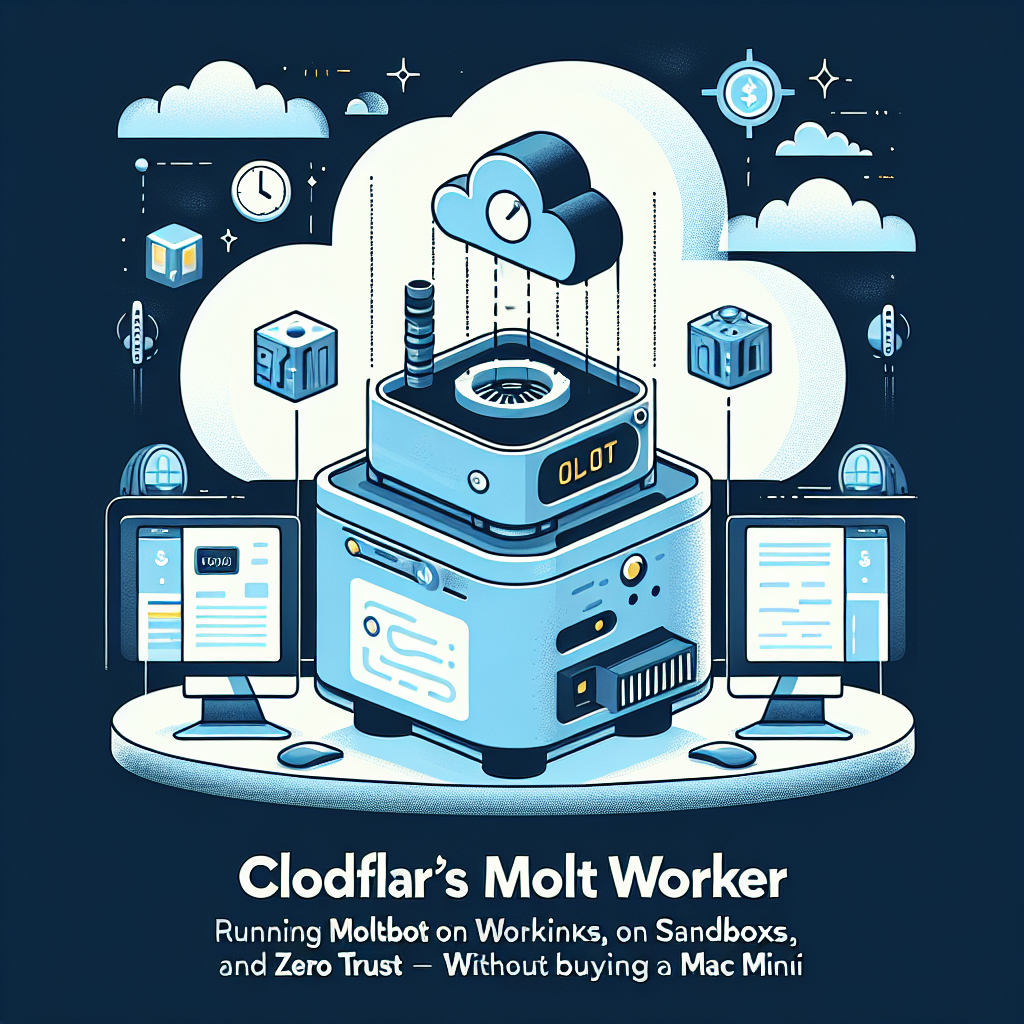
For a few days in late January 2026, the internet briefly looked like it was sponsored by Apple’s smallest desktop. Social timelines filled with proud photos of freshly purchased Mac minis—“for an AI agent,” people insisted, as if that completely explained the decision to buy a tiny aluminum box to sit in a corner and quietly run errands.
The agent in question is Moltbot (formerly “Clawdbot”), an open-source, self-hosted personal assistant designed to live on your own hardware, integrate with chat platforms, call out to large language models, and automate actions like browsing, scheduling, and other “computer stuff” we humans are tired of doing. Cloudflare’s latest move is essentially a gentle, slightly smug question: what if you could run that always-on assistant without buying any new hardware at all?
Enter Moltworker, a proof-of-concept implementation from Cloudflare that runs Moltbot on Cloudflare’s developer platform—specifically by combining Cloudflare Workers, Sandboxes (via the Sandbox SDK), Browser Rendering, R2 object storage, AI Gateway, and Zero Trust Access. The project was introduced on January 29, 2026 in the Cloudflare blog post Introducing Moltworker: a self-hosted personal AI agent, minus the minis by Celso Martinho, Brian Brunner, Sid Chatterjee, and Andreas Jansson. That post is the original RSS source for this article and the foundation for what you’re reading here.
Cloudflare also published the code at cloudflare/moltworker, explicitly calling it experimental and not an official Cloudflare product. Still, it’s one of those “proof of concept” projects that feels like a neon sign for where the platform wants developers to go next: agentic apps, running close to users, executing untrusted code safely, with observability and access controls baked in.
What Moltworker actually is (and what it isn’t)
Moltworker is best described as a middleware wrapper around Moltbot that makes it possible to deploy Moltbot into a Cloudflare-managed environment instead of a box under your desk. It’s not a new agent from scratch; it’s an adaptation layer.
At a high level, Cloudflare’s blog describes Moltworker as:
- An entrypoint Cloudflare Worker that routes API requests and proxies traffic between Cloudflare services and an isolated runtime.
- A Sandbox container where Moltbot’s “gateway runtime” and integrations actually run.
- R2 storage to persist Moltbot state across the inherently ephemeral lifecycle of containers.
- Browser Rendering to offload headless browser automation to a managed service rather than running Chromium inside the container.
- Cloudflare Access (Zero Trust) to protect admin surfaces and APIs so your “personal assistant” doesn’t become the internet’s personal assistant.
- Optionally, AI Gateway to centralize LLM routing, logging, cost visibility, and key management (or Cloudflare-managed credentials via Unified Billing).
The GitHub repository doubles down on the positioning: “Run Moltbot personal AI assistant in a Cloudflare Sandbox.” It’s also unambiguous about risk: experimental, may break, use at your own risk.
Why this matters: the self-hosted agent boom meets “serverless, but with containers”
On paper, Moltbot and Cloudflare Workers sit in different universes.
Moltbot is part of a fast-growing wave of “local-first” (or at least “self-hosted”) AI agents: tools that keep a long-running process alive, integrate with messaging apps, and use LLMs plus tool access to do real actions. These systems often rely on local execution, local file access, persistent memory, and occasionally a web browser that can click things humans click.
Workers—traditionally—are short-lived request handlers designed for stateless, edge-deployed logic. Historically, that made them an awkward fit for “agentic” workloads that want to run continuously and keep state.
Cloudflare’s platform has been quietly expanding into the middle ground: Workers plus durable primitives, managed databases, object storage, and now Sandboxes—which are isolated containers you can control from Workers using a higher-level SDK. Pair that with Browser Rendering and you get a kind of “serverless control plane, container data plane” architecture that is surprisingly agent-friendly.
In other words: Moltworker isn’t just about running Moltbot somewhere else. It’s a demo of a broader thesis: the edge platform can be the orchestration layer for agentic systems, while the risky parts run inside locked-down environments.
The Mac mini problem: dedicated hardware is easy, until it isn’t
Running a personal agent locally sounds comforting: “My data stays with me.” “I’m in control.” “No cloud lock-in.” Also: “I am now the proud owner of an always-on device that needs patching, monitoring, and backups.”
Dedicated hardware has real upsides:
- Predictable environment: it’s your machine, your OS, your files.
- Network locality: it can access local resources easily.
- Privacy by default: fewer third-party services in the middle.
But it also has the downsides of… running infrastructure:
- Security upkeep: OS updates, dependency updates, and a new attack surface if you expose anything remotely.
- Availability: home power outages, ISP issues, router resets, and the classic “I unplugged the wrong thing.”
- Remote access complexity: VPNs, tunnels, auth, and making sure your assistant doesn’t accept commands from strangers.
Cloudflare’s pitch with Moltworker is basically: keep the “self-hosted” spirit (you deploy and control it), but stop treating your personal assistant like a houseplant that needs constant watering.
A quick detour: Moltbot’s name change and the security circus that followed
Moltbot’s quick rise has been… eventful. The project was originally called Clawdbot and was renamed to Moltbot after a trademark conflict involving Anthropic’s Claude branding and mascot. Reporting around the rename highlights that creator Peter Steinberger said he was forced to change the name, and that the rebrand triggered opportunistic scams and account hijacking attempts.
Security researchers also noticed something predictable and depressing: viral open source projects become instant phishing and typosquat targets. Malwarebytes documented an impersonation campaign that appeared around the rename, including typosquatted domains and a cloned GitHub repository positioned for potential supply-chain abuse. If you’re going to self-host a personal agent that can run tools and touch data, the “download it from the right place” step is not optional.
This matters to Moltworker because it sits at the intersection of three risky forces:
- Viral open source (attractive target)
- Agents with tool access (high-impact compromise)
- Easy deployment templates (fast adoption, but also fast mistakes)
Under the hood: how Moltworker maps Moltbot’s needs to Cloudflare’s platform
Cloudflare’s post is unusually transparent about the building blocks involved. If you squint, Moltworker is a tour of Cloudflare’s “agents stack.” Let’s break down each component and why it exists.
1) Workers: the edge entrypoint and control plane
The entrypoint Worker is doing the web-native parts: routing requests, acting as a proxy, handling authentication checks, and offering an administration UI. It’s also the bridge between the outside world and the sandboxed runtime where Moltbot runs.
This design makes sense because Workers are excellent at:
- HTTP handling
- Middleware logic
- Integrations with other Cloudflare services
- Global, low-latency availability
Cloudflare’s broader point is that Workers have become much more compatible with the Node.js ecosystem, which reduces friction when adapting real-world JavaScript tooling. Cloudflare documents that enabling Node.js APIs typically involves the nodejs_compat flag and a relevant compatibility date, and that more core Node APIs are supported natively over time.
2) Node.js compatibility: the boring platform work that makes demos possible
Cloudflare has been pushing Node.js compatibility hard, and Moltworker is a beneficiary of that effort. The Workers docs outline how Node.js APIs are supported either natively by the runtime or via polyfill shims, with nodejs_compat acting as the primary switch.
One concrete example is node:fs. Cloudflare now provides a virtual file system API for Workers that can be used when Node compatibility is enabled—useful for certain libraries and workflows, even if it’s ephemeral by design. Cloudflare’s changelog and documentation emphasize that this file system is not persistent across requests, which is exactly why Moltworker still needs R2 for durable storage.
It’s not glamorous, but it’s foundational: the more “normal Node” Workers becomes, the more feasible it is to run serious JavaScript apps at the edge—or at least run their control planes there.
3) Sandboxes: run untrusted code in isolated containers (without DIY container orchestration)
Agents don’t just call APIs—they execute. They install packages, run scripts, sometimes compile things, sometimes do tasks that are safer behind a blast wall. In Cloudflare’s Moltworker design, Moltbot’s core runtime lives in a Cloudflare Sandbox, and the Worker controls it via the Sandbox SDK.
The Sandbox SDK provides an API to:
- execute commands
- manage files and directories
- run background processes
- expose services
Cloudflare presents Sandboxes as a way to execute untrusted code securely in isolated environments. For an agent that might download tools (like ffmpeg in Cloudflare’s demo) or interact with external content, that isolation isn’t a luxury—it’s table stakes.
Architecturally, this is the key twist: instead of Moltbot running Docker locally on a Mac mini, the containerized runtime is hosted on Cloudflare’s infrastructure, and Workers issue commands into it through a managed interface.
4) R2: persistent storage for an otherwise ephemeral runtime
Containers are ephemeral. Personal assistants, sadly, are expected to remember things.
Cloudflare’s approach is to mount an R2 bucket into the sandbox file system using a mechanism the Sandbox SDK supports (the Cloudflare blog describes using sandbox.mountBucket()). This gives Moltbot a place to store conversation history, memory files, and other assets that need to survive restarts.
It’s a classic separation of concerns:
- Compute is disposable (sandbox container can restart)
- State is durable (R2 persists data)
This is also where a lot of real-world “agent reliability” lives. If your agent loses memory every time the container restarts, you’ll quickly discover how much of your life is just re-explaining your preferences to software.
5) Browser Rendering: managed headless browsers as an API
Agent demos love browsers for the same reason humans do: the web is where the stuff is. Moltbot uses Chromium automation to navigate, fill out forms, take screenshots, and perform tasks.
Cloudflare’s Moltworker design can run Chromium in the sandbox, but it chooses another route: Cloudflare Browser Rendering, which provides headless browser instances you can control programmatically. The blog describes building a thin proxy using CDP (Chrome DevTools Protocol) so the sandboxed Moltbot runtime can talk “locally” to a CDP port that actually routes to Browser Rendering.
Cloudflare’s Browser Rendering documentation also highlights support for popular automation stacks like Puppeteer and Playwright, and even newer agent-friendly options like Stagehand, an AI-powered automation library intended to be more resilient when websites change. Stagehand support in Cloudflare’s docs is explicit about supported versions, which is the kind of detail you only learn to care about after your automation breaks on a random Tuesday.
Why does managed browser automation matter?
- Operational simplicity: no fiddling with Chromium in a container image.
- Scalability: browsers are heavy; outsourcing them can be pragmatic.
- Security isolation: browser workloads can be contained.
Of course, it also introduces a dependency: if your agent’s “hands” are an API, you now care about service limits, latency, and cost.
6) Cloudflare Access (Zero Trust): put authentication in front of everything
A personal AI agent is a weird security object. It’s personal, but it’s also a remote-control interface. If it integrates with Slack, Telegram, or Discord and can trigger actions, the threat model expands quickly.
Moltworker leans on Cloudflare Access to protect both APIs and the admin UI. The Cloudflare blog points out that Access can enforce policies and login methods for endpoints, and can include JWTs in requests to the origin that you can validate for extra assurance.
The GitHub README for Moltworker makes Access feel less like an optional add-on and more like a required step: enabling Access on the worker and pairing devices via the admin UI are positioned as must-do tasks before using the control UI.
This is probably the most important “enterprise lesson” embedded in the project: an agent is only as secure as its weakest integration, and rolling your own authentication in 2026 is a hobby for people who enjoy pain.
7) AI Gateway: routing, observability, and fewer secrets in weird places
Moltbot can talk to multiple AI providers. Moltworker’s blog post spotlights Cloudflare AI Gateway as a proxy that gives centralized logging, analytics, and routing across providers.
Two features matter a lot in practice:
- BYOK (Bring Your Own Key): Cloudflare can store and manage provider keys so you don’t ship them around as plain text with every request.
- Unified Billing: you load credits into Cloudflare and access multiple providers through AI Gateway, receiving a single bill. Cloudflare’s documentation also describes spend limits and a Zero Data Retention (ZDR) option for Unified Billing traffic that uses Cloudflare-managed credentials.
For a personal agent, the immediate win is operational: one place to see usage, latency, and cost. The strategic win is portability: if you want to switch models or add fallbacks, you can do it at the gateway rather than redeploying your agent every time a new model drops and your group chat gets excited.
Moltworker in action: what Cloudflare demoed (and why it’s not just fluff)
Cloudflare’s blog includes demos of Moltworker-driven Moltbot interactions via Slack, including:
- Using Google Maps to find the shortest route between Cloudflare offices and posting a screenshot.
- Finding restaurants (“we’re in the mood for some Asian food today”).
- Generating a video by browsing documentation and using ffmpeg to stitch frames together.
Demos are demos, but these are meaningful choices. Each one exercises a different part of the architecture:
- Browser Rendering for navigation and screenshots
- Sandbox execution for installing/running tools like ffmpeg
- Persistent memory (the agent remembering context across requests)
- Chat integration as the user-facing control layer
If your agent can browse, execute commands, and persist memory, you’re already in “useful but dangerous” territory. Which brings us to the question everyone should ask next.
The security implications: putting an agent on the internet is not the same as running it at home
The appeal of self-hosted agents is control. The risk is that “control” is exactly what attackers want.
Even with Cloudflare Access and sandbox isolation, there are still serious considerations:
Prompt injection and web-driven tool abuse
Browser automation plus LLM reasoning is a recipe for prompt injection. Malicious content on a webpage can try to manipulate the agent into taking actions it shouldn’t—especially if the agent has broad tool permissions.
Cloudflare’s architecture helps by isolating execution in Sandboxes and protecting entrypoints with Access, but it doesn’t magically solve the agent alignment problem. If the agent is allowed to do something, an attacker’s goal is to convince it to do that thing at the wrong time for the wrong reason.
Supply-chain and typosquat risk
As noted earlier, Malwarebytes documented impersonation infrastructure around the Moltbot rename, including cloned repositories and typosquatted domains. The more “one-click deploy” a project becomes, the more important it is that developers verify they’re deploying the real code.
Credential handling
Agents love credentials. They need API keys for LLMs, tokens for chat integrations, possibly OAuth tokens for services, and maybe access to personal data stores. AI Gateway’s key management and Cloudflare secrets handling can reduce exposure, but you still have to treat the whole deployment as a sensitive system.
Access policies and least privilege
Cloudflare Access makes it easier to enforce authentication, but you still need to configure policies correctly. For teams, that means thinking about who can pair devices, who can access admin UI paths, and how to revoke access quickly if a device is compromised.
Practical advice: if you’re experimenting with Moltworker, start with a “toy” deployment that has no access to sensitive accounts or financial services. The first version of any agent should be treated like an intern who is enthusiastic, confident, and unsupervised.
Cost and practicality: do you really save money versus buying the mini?
Cloudflare’s Moltworker repository lists the Workers Paid plan ($5/month) as a requirement for Sandbox containers. It also notes that other services used may have free tiers (Access, Browser Rendering, AI Gateway, R2), and that you’ll need an Anthropic API key for Claude access unless you use AI Gateway Unified Billing.
But total cost of ownership isn’t just “$5/month versus $599 one-time.” It depends on:
- How often your agent uses browser automation (browsers are expensive workloads)
- How much LLM traffic it generates (model costs dominate quickly)
- How much data you persist in R2
- How much you value uptime and not maintaining hardware
The realistic takeaway is that LLM usage will likely dwarf infrastructure costs for most non-trivial agents. Moltworker’s platform costs may be a rounding error compared to the model bill—especially if you let your assistant “helpfully” summarize the entire internet every morning.
Where this fits in the broader agent ecosystem
Moltworker is one example of a broader shift: “agents” are forcing infrastructure platforms to support a hybrid of:
- event-driven request handling
- durable state
- secure code execution
- browser automation
- observability across model calls
Cloudflare is not alone in chasing this. Many platforms are converging on similar primitives: isolated execution environments, managed storage, and guardrails. What’s distinctive here is Cloudflare’s angle: the control plane at the edge, protected by Zero Trust, with managed “heavy” services (containers, browsers) behind it.
Also, Cloudflare’s emphasis on Node.js compatibility is not just developer convenience—it’s a strategic bet that the massive npm ecosystem is the on-ramp for whatever comes after “web apps” as we know them.
How to try Moltworker (high-level, not a copy-paste tutorial)
If you want to run Moltworker yourself, the canonical starting point is the GitHub repository cloudflare/moltworker, which includes a README with a deploy flow and configuration details.
At a high level, expect to:
- Have a Cloudflare account with a Workers Paid plan (for Sandboxes)
- Configure secrets (LLM key or AI Gateway credentials, plus a gateway token)
- Deploy the Worker
- Enable Cloudflare Access for the worker’s admin UI and endpoints
- Pair your device in the admin UI
- (Optional but recommended) Enable R2 persistence so restarts don’t wipe state
Cloudflare notes that the first request can take a bit while the container starts. That’s a reminder that even in “serverless land,” long-running agent infrastructure still has lifecycle behavior you’ll feel.
The bigger picture: “self-hosted” is evolving into “self-controlled”
The most interesting part of Moltworker is the philosophical shift it represents.
For years, “self-hosted” meant “I run it on my own machine.” But as agents become more capable, “my own machine” becomes less about sovereignty and more about burden. What people often want is self-controlled:
- I decide what code runs
- I control access
- I can audit usage
- I can move it if I need to
- I’m not locked into a single vendor’s closed assistant
Moltworker tries to land in that middle ground. You still deploy an open-source agent, you can inspect the code, and you can manage integrations. But you’re outsourcing parts of the operational complexity to a platform that (theoretically) does this at scale with better security defaults than a random home network.
It won’t satisfy purists who want everything on a LAN with a blinking LED. But for a lot of developers, it’s a practical compromise: the agent stays “yours,” while the infrastructure stops being “also your hobby.”
What to watch next
Moltworker is explicitly labeled a proof of concept, but it points toward likely near-term developments:
- More agent-friendly primitives on cloud platforms: secure execution, durable memory, built-in tool connectors.
- Stronger guardrails for browser automation and tool execution: policy engines, allowlists, scoped permissions.
- Standardization pressure: MCP and similar approaches hint at a future where tools and agents interoperate more cleanly.
- Security tooling specific to agents: prompt injection monitoring, action auditing, and least-privilege enforcement for tool calls.
In the short term, Moltworker will likely be used by curious developers who want to run Moltbot without dedicating hardware, and by platform watchers who want to see how far “Workers + containers” can stretch. In the medium term, the real impact may be subtler: it normalizes the idea that agents are a deployment target for edge developer platforms, not just a novelty living on someone’s desktop.
Sources
- Cloudflare Blog: “Introducing Moltworker: a self-hosted personal AI agent, minus the minis” (Celso Martinho, Brian Brunner, Sid Chatterjee, Andreas Jansson; January 29, 2026)
- GitHub: cloudflare/moltworker (project repository and README)
- Cloudflare Workers Docs: Node.js compatibility
- Cloudflare Workers Docs: node:fs (virtual file system)
- Cloudflare Changelog: Node.js and Web File System APIs in Workers
- Cloudflare: Sandbox SDK overview
- Cloudflare Browser Rendering Docs: Stagehand
- Cloudflare AI Gateway Docs: Unified Billing
- Cloudflare: AI Gateway product overview
- Malwarebytes: “Clawdbot’s rename to Moltbot sparks impersonation campaign” (Stefan Dasic; January 29, 2026)
- The Verge: report on Moltbot/Clawdbot and security concerns (January 2026)
- Business Insider: coverage of the Clawdbot-to-Moltbot rename (January 2026)
Bas Dorland, Technology Journalist & Founder of dorland.org