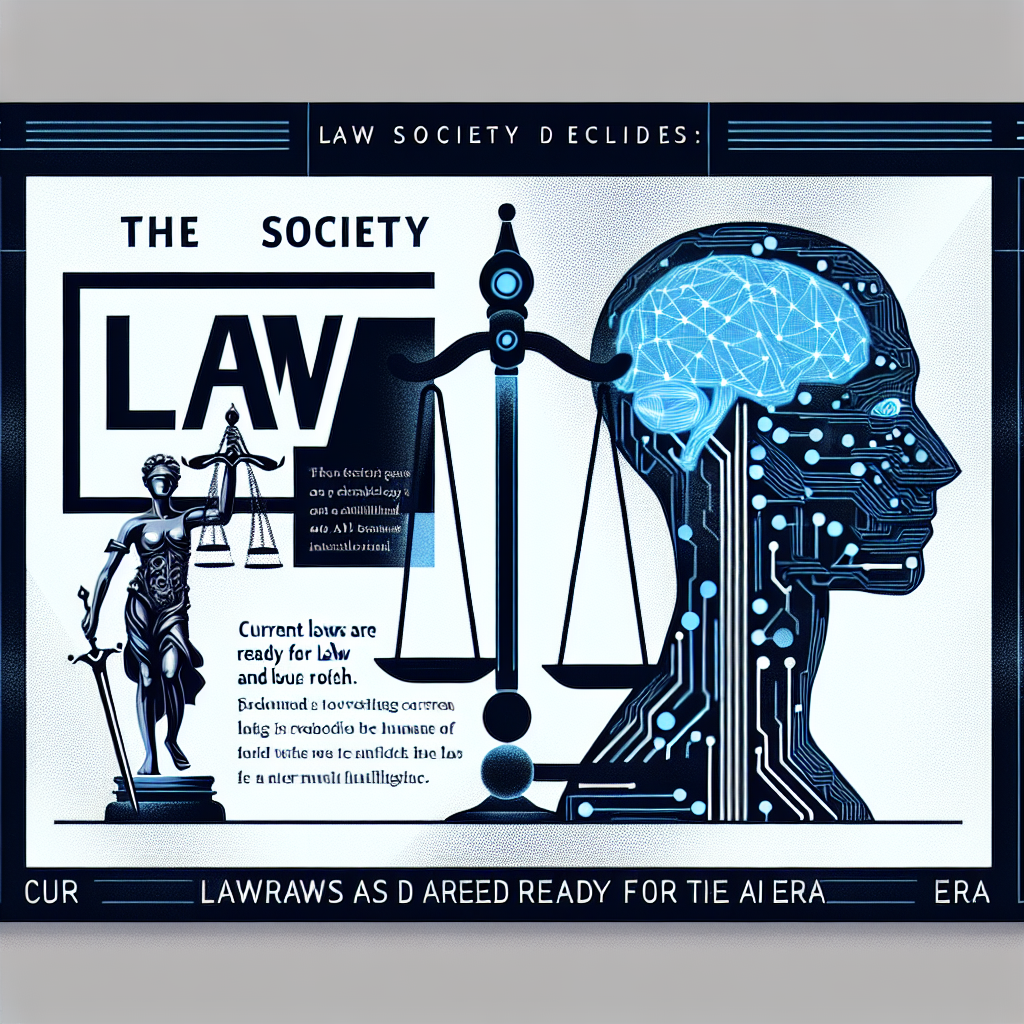
The AI Age and Law: A Match Made in the Boardroom
Ah, artificial intelligence—the ever-encroaching future that promises everything from self-driving cars to chatbots that don’t frustrate you. But as AI continues to cement itself into the very fiber of multiple industries, the burning question lingers: Are our current legal frameworks up to snuff to handle this technological marvel?
The Law Society seems to think so. In a recent statement by its CEO, Ian Jeffery, a reassuring stance was taken: the existing legal framework is more than capable of supporting AI’s gallop into the future. This declaration has been the equivalent of a legal mic drop, leaving many to ponder if the spotlight-shy legal industry is, in fact, ahead of the curve.
What Exactly Is a Law Society?
For the uninitiated, a law society is no secret society of wig-wearing barristers plotting world domination, though the imagery is amusing. It’s an association of lawyers responsible for ensuring that legal professionals are well-trained, properly qualified, and ethically bound. Law societies are vital regulators in jurisdictions around the globe, including the UK, Canada, and Australia.
The Law Society of England and Wales emerged as a powerful advocate for legal professionals, often acting as both regulator and trade association. Fast forward to the present, its role in supervising legal practice is still crucial, though now it shares responsibilities with government-backed regulators. The question remains: How does this body perceive the impact of today’s innovative digital age?
The AI Challenge: Data, Skills, and… Uncertainty
Ian Jeffery’s recent commentary shines a light on an interesting dichotomy. While the legal infrastructure is ready to strut its stuff on the AI fashion runway, the runway itself has a few bumps. “The main challenges don’t stem from regulatory burdens,” Jeffery notes, “but rather from uncertainty, cost, data, and skills associated with AI adoption.”
Translation: Legal challenges hover more around the unpredictability of AI, the intimidating price tags of its implementation, and a workforce still trying to navigate the intricacies of data and machine learning. For a field that thrives on precision, these grey areas can be daunting.
The Real-World Implications
The reassurances from legal bodies serve as a green light for innovators who might have been choking on apprehension. Knowing the legal parameters are fortified against digital trends offers relief. Yet, until technology meets with understanding and proficiency on a grand scale, there’s more work to be done.
Conclusion
The era of AI might still be young, but its implications are vast. The Law Society’s declarations give credence to the idea that our laws are adaptable, built to guide us through murky technical waters. Still, as innovations spearhead through technologies unknown, maintaining the flexibility and understanding to foster development will be crucial.
The conversation continues, and one thing is clear: the march of progress waits for no one—not even the weight of traditional legal frameworks. Until then, consider us all unwitting participants in the next episode of “Welcome to the AI Era.”