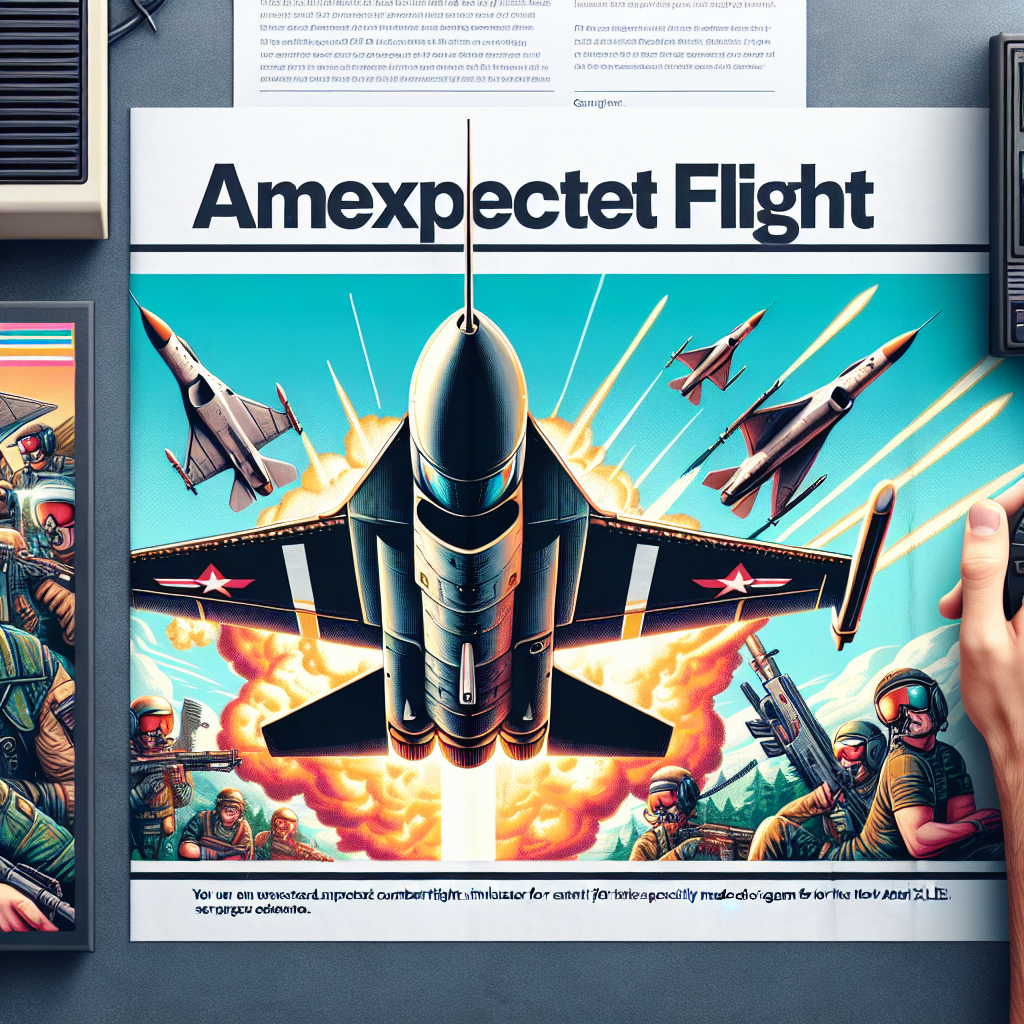
Somewhere in the multiverse, there’s a timeline where the Atari 65XE is a respected platform for modern combat flight simulators. In our timeline, that idea sounds like a prank—until you boot F-16 Falcon Strike and realize the joke is on you.
F-16 Falcon Strike is a new 3D, six-degrees-of-freedom (6DoF) combat flight simulator for Atari XL/XE computers, created by Jarosław “Roeoender” Wosik. It’s not a remake of an older title or a tech demo in disguise. It’s a full-on sim with a structured campaign, configurable difficulty, weapons, radar modes, moving ground units, and enough cockpit instrumentation to make your joystick feel underqualified for the job.
This article is based on the original release information and documentation on the game’s official page, F-16 Falcon Strike, authored by Jarosław “Roeoender” Wosik. (The site lists the project as © 2023–2025 and notes the latest version as 1.5.0, released on February 8, 2025.) citeturn5view0
What is F-16 Falcon Strike?
At its core, F-16 Falcon Strike puts you in the cockpit of a Polish Air Force F-16 defending Poland and the EU border in a fictional scenario dubbed the “Królewiec Campaign.” It’s a campaign made up of 15 handcrafted missions, mixing air-to-air engagements with strike and support tasks, and it’s built around a world where targets move and missions can fail if ground forces reach their objectives. citeturn5view0
The game first appeared publicly around the ABBUC Software Contest 2024 timeframe. Roeoender announced the release on AtariAge on October 27, 2024, calling it his first Atari 8-bit game and emphasizing the 3D/6DoF nature of the sim on a 64KB machine. citeturn4view0
And yes: the community noticed. In the same AtariAge thread, commenters compared the vibe to classic sims and noted the surprising quality level for a contest entry—while Atarimania later recorded the game as finishing fourth place in the ABBUC Software Contest 2024. citeturn6search0turn4view0
Why this is a big deal in 2025 (and still in 2026)
It’s easy to forget how unfriendly the Atari 8-bit environment is to anything that resembles “modern 3D.” You’re dealing with a MOS 6502 family CPU, modest RAM (the game targets 64KB), and video hardware from a time when “vector graphics” was a marketing flex and not a runtime expectation.
Yet Roeoender’s own feature list claims some notable “firsts,” including that it’s the first new 3D combat flight simulator for Atari XL/XE in over 35 years, and the first Polish 6DoF 3D vector game of its type on the platform. citeturn5view0
Even if you treat “firsts” with a journalist’s healthy squint, the practical result is undeniable: this is a serious new flight simulator on a platform that most people associate with River Raid, not radar cones and g-force effects.
The campaign: 15 missions, not 15 excuses
Many retro “new releases” lean on nostalgia and stop at “it runs.” F-16 Falcon Strike goes further by delivering an honest-to-goodness campaign structure:
- 15 missions with text briefings, waypoints, and specific victory conditions citeturn5view0
- Multiple mission types (air combat, bomber interception, support, bombing raids, and stopping ground units before they reach objectives) citeturn5view0
- Campaign progress that saves to disk after flights citeturn5view0
- Different mission outcomes illustrated with original GTIA graphics citeturn5view0
That save-to-disk detail matters more than it sounds. On real hardware, the game uses an ATR disk image and expects it not to be write-protected because it persists campaign state. citeturn5view0
In other words, it’s designed like a “real” game, not a demo you re-run from scratch every time the cat brushes the power switch.
Flight model and simulation knobs: the part where it stops being an arcade toy
Roeoender describes the flight model as self-designed and “advanced (as of 8bit platform),” including lift/drag calculations and angle-of-attack behavior. The game also models how aircraft performance changes with loadout and altitude (atmospheric density factor). citeturn5view0
That alone would be ambitious; the game then adds a matrix of difficulty settings. The official documentation lists seven adjustable difficulty areas, including hitpoints, malfunctions, countermeasures, weapon realism, enemy experience, enemy amount, and landing difficulty. citeturn5view0
A difficulty system that’s actually… thoughtful
One of my favorite details is that the settings aren’t just “easy means fewer enemies.” The game’s “Weapon realism” and radar-lock constraints change how you fight:
- On easier weapon settings, you can do more damage with less optimal weapons (and easy can include unlimited ammo). citeturn5view0
- On hard weapon realism, radar lock is constrained to a forward detection cone (128 degrees), and lock can be lost if the target leaves that cone. citeturn5view0
This is a clever way to scale difficulty without simply turning enemies into bullet sponges or turning the player into a flying tank.
Weapons, sensors, and the business of not getting shot down
For a sim on an 8-bit machine, the weapon set is surprisingly broad. The official feature list includes:
- Cannon
- Unguided rockets
- Bombs
- Guided missiles (A2A: AIM-9L Sidewinder, AIM-120 AMRAAM; A2G: AGM-65 Maverick; anti-radar: AGM-88 HARM) citeturn5view0
It also spells out some rules of engagement that hint at deeper modeling. Example: Sidewinders are infrared-guided and can only lock in the target’s rear hemisphere. citeturn5view0
As of version 1.4.0, cannon rounds and rockets became ballistic (gravity-affected), forcing lead and range judgment to matter more—plus cannon rounds were slowed, demanding more predictive aiming in air-to-air fights. citeturn5view0
This isn’t just “press fire until the sprite disappears.” It’s trying, within the constraints of the platform, to teach the player to fly and fight with at least a little discipline.
Version history: a fast-moving retro project
One way to tell whether a retro release is a weekend novelty or a real ongoing project is to look at the cadence of updates. F-16 Falcon Strike has a detailed public release timeline on its official page, starting with the initial ABBUC contest release and iterating quickly into 2025. citeturn5view0
Highlights from the official changelog include:
- 1.0.0 (July 31, 2024): initial release for ABBUC 2024 software contest citeturn5view0
- 1.3.0 (January 1, 2025): mission time-of-day and weather conditions; cockpit changes; landing gear affecting roll rate citeturn5view0
- 1.4.0 (January 14, 2025): radar cone constraint on hard weapon realism; ballistic trajectories; major performance optimizations citeturn5view0
- 1.5.0 (February 8, 2025): g-force visual effects (blackout/greyout/redout), cockpit shake, explosion animations, integrity checks, and more optimizations citeturn5view0
Two things stand out here. First: the project isn’t just feature-stacking; it’s optimizing and refining game feel (ballistics, lock behavior, cockpit feedback). Second: it’s very “software-engineering aware,” adding integrity checks and shaving cycles in the rendering pipeline.
The 3D engine: vector graphics, but with modern expectations
Roeoender lists 17 varied 3D objects including aircraft, ground vehicles, radars, bridges, mountains, and explosions. To improve frame rate, most objects have two levels of detail. citeturn5view0
That LOD detail matters because it’s one of those techniques we associate with “real” 3D engines on later systems—yet here it is on Atari XL/XE, used as a pragmatic way to keep performance acceptable.
The sim also changes visuals with altitude (ground and sky hue) and supports multiple times of day and weather, including night and overcast. citeturn5view0
Why vector-style 3D still works in 2026
Vector graphics aren’t just a nostalgia aesthetic. On constrained hardware, they’re a legitimate rendering strategy: lines and polygons can be cheaper than filled sprites or bitmap-heavy scenes, especially when you’re also budgeting CPU time for physics, AI behaviors, UI updates, and disk operations.
In other words: “retro 3D” is not only charming, it’s a sensible design choice when your CPU was originally intended to run BASIC programs and maybe an occasional word processor if nobody’s looking.
World simulation: enemies don’t spawn, they launch
One feature that deserves more attention is the game’s approach to the battlefield as a system. In the official feature list:
- Ground units move and can trigger mission failure if they reach goals citeturn5view0
- Enemy fighters “don’t appear out of thin air” and take off from runways after you’re identified as hostile citeturn5view0
- You must identify friend/foe because friendly structures and vehicles exist in the world citeturn5view0
This is how you build tension in a sim: you’re not just clearing a screen, you’re managing a situation. Even on modern platforms, that sort of “living world” logic is what separates a mission-driven sim from a shooting gallery with a horizon line.
How to run it: real hardware, emulators, and the unglamorous truth about disks
According to the official “Running instructions,” the game was tested on a real Atari 65XE PAL with SDrive Mini, and should be playable on NTSC (with slightly different colors). It’s packaged as a 130KB ATR disk image using XBOOT Loader and XBIOS, and it saves campaign state to disk. citeturn5view0
It was also tested on the Altirra emulator (the page mentions 4.20+). citeturn5view0
Altirra matters because accuracy matters
Altirra isn’t “just another emulator.” It’s widely regarded in the Atari scene as a high-accuracy emulator and debugger, and it continues to evolve. Community posts about Altirra 4.20 describe a large set of improvements across devices, save states, debugger features, and emulation accuracy. citeturn6search5turn6search3
From a developer’s point of view, a strong emulator toolchain reduces friction: you can iterate faster, debug deeper, and still validate on real hardware when you’re ready to face the music (and by “music,” I mean timing quirks and weird GTIA behavior).
SDrive and the modern Atari workflow
Hardware loaders like the SDrive family (including SDrive-MAX) exist because nobody wants to shuffle floppies like it’s 1987—unless that’s specifically their hobby, in which case: carry on, you magnificent weirdo. Modern devices can emulate multiple floppy drives and load ATR images from SD cards. citeturn2search2turn2search3
That ecosystem is a big reason why ambitious new Atari software is practical now. It’s not just about coding skill; it’s about distribution, convenience, and making it easy for players to actually run the thing.
Rapidus support: because some people like their 8-bit with a turbocharger
Roeoender also ships a separate version for accelerated Atari systems (for example with Rapidus), and notes that in that accelerated version you can control simulation speed with keys 9 and 0. citeturn4view0turn5view0
This is the retro equivalent of offering a “high refresh rate mode.” The base game targets 64KB stock machines, but the accelerated build acknowledges that part of the Atari community has upgraded hardware and wants to push beyond stock performance constraints—especially for a 3D sim where frame rate equals comfort and survivability.
Toolchain and credits: modern retro development is still development
The credits on the official site read like a tour of contemporary Atari 8-bit development tools. Roeoender explicitly thanks:
- Mad-Pascal and Mad-Assembler (MADS) by TeBe/MadTeam citeturn5view0
- Atari Graphics Studio, MAD Studio, Rasta Converter, xBIOS, BLIBS citeturn5view0
- Altirra by Avery Lee citeturn5view0
Mad-Pascal, in particular, is positioned as a Turbo Pascal-style compiler targeting Atari 8-bit and other 6502 systems, with documentation hosted by its author. citeturn1search2
Meanwhile, MADS is a cross-assembler for 6502/65816, also maintained in the modern era. citeturn1search0turn1search1
Translation: this wasn’t made by typing PEEKs into a magazine listing. This is a modern build pipeline aimed at getting serious performance out of old silicon.
Music: a 1992 CMC track shows up in a 2025 flight sim
The official credits also mention that the briefing music “Raszyn 1809” was composed and converted into a CMC song by Jakub Husak in 1992, and used with permission. citeturn5view0turn6search0
That’s a wonderfully Atari-specific cross-generational detail: a 1992 composition living inside a modern retro release, like a time capsule that learned to fly.
Comparisons: where does F-16 Falcon Strike sit in the flight sim lineage?
The immediate point of reference for many Atari and 8-bit fans is MicroProse’s golden era: sims where “read the manual” wasn’t a meme, it was survival gear. In the AtariAge thread, one user explicitly recalled pounding F-15 Strike Eagle on an 800XL as a kid, and called Falcon Strike “amazing.” citeturn4view0
F-16 Falcon Strike isn’t trying to replicate the exact complexity of PC sims from the 1990s. Instead, it borrows the philosophy: information-rich cockpit, mission structure, and a learning curve that rewards practice rather than button mashing.
Vector 3D vs. bitmap cockpits: a pragmatic retro tradeoff
Classic sims often used bitmap cockpit art and sprite-based action. Falcon Strike embraces a more vector-forward 3D look, likely because it’s computationally and memory efficient for what it’s trying to do—while still enabling a cockpit UI with HUD/MFD behavior and navigation maps. citeturn5view0
The result feels less like a “port of a PC sim” and more like a bespoke Atari sim that plays to the platform’s strengths.
Gameplay learning: documentation and tutorials (yes, really)
Roeoender points players to a video tutorial as the best way to learn the game, and Atarimania also highlights that tutorial as an official resource. citeturn5view0turn6search0
This is another “modern dev” behavior that’s become normal in today’s indie scene but is still unusual to see around an Atari XL/XE release: documentation that evolves with versions, plus training resources designed to help people get over the initial barrier.
And let’s be honest: flight sims need that. If your first experience is “I took off and immediately learned the difference between gravity and dignity,” you want a guide.
Distribution and licensing: freeware vibes, but with conditions
The official site’s changelog notes that version 1.4.0 updated the “About” screen to specify distribution conditions and prohibit commercial use without written permission. citeturn5view0
That’s a sensible middle ground for retro creators: share the work widely, but keep control over commercial exploitation—especially when physical releases, compilations, or monetized re-uploads can pop up faster than an AIM-120 on a radar lock.
Cybersecurity angle (because I can’t help myself): integrity checks on an Atari flight sim
One small but fascinating line in the 1.5.0 changelog is “Added code integrity checks.” citeturn5view0
In 2026, we talk about integrity checks in the context of secure boot, supply chain security, tamper detection, and anti-cheat systems. Seeing the concept show up in an Atari 8-bit flight sim is equal parts hilarious and admirable.
To be clear, this doesn’t suddenly make your Atari a “secure computing platform.” But it does show that even retro developers are thinking in terms of robustness: detecting corruption, avoiding weird crashes, and ensuring builds behave as expected in a world where disk images get copied, modified, and passed around.
What F-16 Falcon Strike says about the Atari scene right now
There’s a bigger story here than one impressive game.
The Atari 8-bit scene has quietly grown a modern production stack: cross-compilers, IDEs, graphics tools, emulator debugging, SD-based loaders, and a community that still organizes contests like ABBUC. That combination creates a feedback loop: ambitious projects become feasible, they attract attention, and the next creator aims higher.
Falcon Strike sits right in the middle of that loop. It’s ambitious enough to be newsworthy, polished enough to be playable, and iterative enough to be credible as a maintained piece of software rather than a one-and-done release.
In other words: it’s a reminder that “retrocomputing” isn’t just collecting; it’s still building.
Where to get it (and why you should use the official page)
The canonical home for the project is Roeoender’s page on WebChrono, which includes downloads, a changelog, feature lists, screenshots, and running instructions. If you’re going to play it—or review it, stream it, or archive it—start there:
- Official F-16 Falcon Strike page (WebChrono) citeturn5view0
There are also community archive listings, like Atarimania’s entry for the game, which notes the ABBUC 2024 placement and provides version listings and references back to the official page. citeturn6search0
Practical tips if you’re new to the sim
These are not “secret cheats,” just the kind of advice you’d give a friend before their first sortie:
- Start with easier hitpoints and landings if you’re new. The game explicitly recommends starting EASY for hitpoints, and landings can be made more forgiving. citeturn5view0
- Use the map and MFD modes. The official tips mention using the right MFD mode to determine target distance. citeturn5view0
- Respect effective ranges. The game’s own tips emphasize firing only within effective weapon ranges. citeturn5view0
- In emulation, use warp carefully. The official tips mention Altirra “warp speed” for long flights—useful, but don’t overshoot waypoints like you’re speedrunning aviation. citeturn5view0
The bottom line
F-16 Falcon Strike is proof that “8-bit” doesn’t have to mean “simple.” Jarosław “Roeoender” Wosik didn’t just squeeze a flight sim onto an Atari XL/XE—he built a living campaign-driven combat simulator with configurable realism, a credible 3D engine, and a development pace that looks more like modern indie software than retro hobbyware.
And if you’re wondering whether it’s worth your time: the AtariAge thread reactions tell you what you need to know. Even people who don’t usually play flight sims showed up to say: this is jaw-dropping work. citeturn4view0
Now, if you’ll excuse me, I need to go explain to my 2026 gaming PC why it just got shown up by a 64KB computer from the Reagan era.
Sources
- F-16 Falcon Strike (official site) — Jarosław “Roeoender” Wosik citeturn5view0
- AtariAge forum thread: “F-16 Falcon Strike (flight simulator)” — post by roeoender (Oct 27, 2024) citeturn4view0
- Atarimania: F-16 Falcon Strike — entry noting ABBUC 2024 placement and versions citeturn6search0
- AtariCovers: F-16 Falcon Strike — download links and overview citeturn3search2
- Mad-Pascal documentation — TeBe/MadTeam citeturn1search2
- MADS (Mad-Assembler) official site — TeBe/MadTeam citeturn1search0turn1search1
- AtariAge: “Altirra 4.20 released” — summary and link to changelog citeturn6search5
- Emu-Land: Altirra v4.20 news post — change list and reference link citeturn6search3
- Atari8bit.net: UNO2SIO / SDrive-MAX notes — overview of SDrive-MAX behavior on SIO chain citeturn2search2
- The Brewing Academy: SDrive-MAX product page — description of SDrive-MAX capabilities citeturn2search3
Bas Dorland, Technology Journalist & Founder of dorland.org