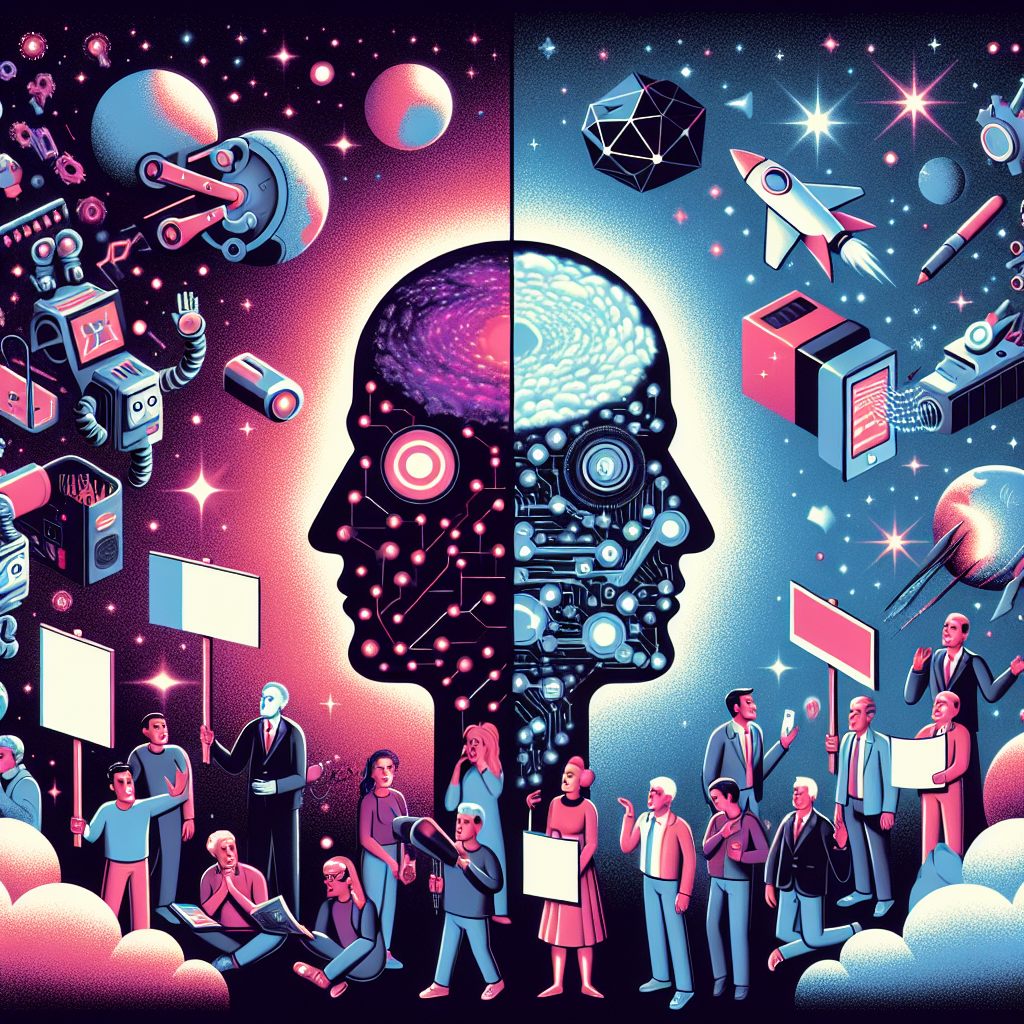
On March 2, 2026, MIT Technology Review published an edition of its weekday newsletter The Download titled “The Download: protesting AI, and what’s floating in space.” The original item (which you can read here: MIT Technology Review) stitches together two storylines that look unrelated at first glance: the intensifying public pushback against AI, and the increasingly crowded mess of human-made objects orbiting Earth.
But put them side by side and a pattern emerges. In both cases, we’re watching the same modern play unfold: a technology gets deployed fast, incentives reward scale over restraint, and the cleanup (legal, social, physical) becomes everyone’s problem. The only difference is whether the spill happens in courtrooms and creative industries, or 550 kilometers overhead at 7.8 km/s.
MIT Technology Review’s The Download is usually a “quick sip of coffee” newsletter. This one is more like a double espresso with a side of existential dread. Let’s unpack the two themes—AI protests and orbital clutter—then connect the dots on where this is heading in 2026 and beyond.
1) The new shape of AI protest: from niche ethics to mainstream pressure
For years, “AI ethics” sounded like a conference track you could skip to go charge your laptop. That era is ending. Protest against AI—how it’s trained, how it’s deployed, and who bears the costs—is getting more organized, more public, and more politically legible.
It’s also increasingly practical. Today’s pushback isn’t just “AI is scary.” It’s “this dataset was taken without permission,” “this model is being used without transparency,” “this deployment harms my job,” or “this product is changing my community’s infrastructure.”
The creative industries are one of the loudest early warning systems
When people talk about AI protests, creators keep showing up as the canary in the coal mine—partly because their work is easy to scrape at internet scale, and partly because generative AI outputs can resemble the inputs closely enough to feel like a copy machine with a law degree.
A vivid example: the U.K. “silent album” protest. In February 2025, more than 1,000 British musicians released a near-silent compilation called Is This What We Want? to protest proposals that would make it easier for AI companies to use copyrighted work for training. The track titles, read in sequence, spell out a pointed message: “The British Government Must Not Legalise Music Theft To Benefit AI Companies.” Proceeds went to the charity Help Musicians. citeturn3news15turn3news13turn3search12
Silent albums are not new as an artistic statement, but here the gimmick is also the policy argument: “If we let unlicensed training become the norm, the future may be quieter for human creators.” It’s protest as product design.
Legislation is becoming a protest venue
In the U.S., one of the most consequential arenas for AI protest is not the street—it’s the hearing room. Consider California’s AB412, which (as described in reporting on a late-2025 hearing at Stanford) drew hundreds of actors, writers, musicians, and digital artists demanding transparency around the use of copyrighted works in AI training. The bill would require AI developers to disclose whether and how registered copyrighted materials were used, and to respond to creators’ inquiries within a set timeframe. citeturn0news13
Whether AB412 (or similar proposals) become law is an open question, but the social dynamic matters: creatives are no longer only suing or complaining—they’re showing up as a coordinated constituency.
“Botlash”: when the backlash becomes a movement
The Financial Times recently described a broader anti-AI swell as “botlash”—a mix of parents, communities, civil rights groups, and workers pushing back against AI deployments and the corporate power behind them. The FT’s framing is useful because it clarifies that AI protest is no longer just about art and copyright; it’s about data centers, governance, and who gets to decide what’s “strategic” enough to dodge regulation. citeturn0news12
That matters for businesses and policymakers because movements tend to produce rules. Sometimes those rules are sensible. Sometimes they’re rushed. But either way, the era of “ship now, apologize later” is getting politically expensive.
2) Why people are protesting AI in the first place (and why it’s complicated)
To understand AI protest in 2026, it helps to break it into buckets. People aren’t objecting to “AI” as a single thing; they’re objecting to specific behaviors and outcomes.
A) Training data and consent: the “original sin” problem
Most modern foundation models were trained on vast corpora of text, images, audio, and video collected at industrial scale. A lot of that material was publicly accessible, but “publicly accessible” is not the same as “licensed for this use.”
Creators argue that if a model learns from copyrighted work and then competes with the creator, the training process is part of the value chain and should require permission and compensation. AI companies often argue that training is transformative, that outputs are not direct copies, and that requiring licenses for everything would freeze innovation or entrench incumbents who can afford the deals.
Whatever your view, it’s clear the “consent layer” of the modern internet was not designed for this. The law is being asked to retrofit a licensing system onto a web that was built to be crawled.
B) Job displacement and labor leverage
When automation is gradual, society adapts (painfully, but adaptively). When it’s fast and uneven, you get protest.
Generative AI threatens not only certain job categories, but also bargaining power. In creative industries, for example, even if AI doesn’t replace the best human work, it can flood the market with “good enough” content and push rates down. The protest isn’t always about the existence of AI; it’s about the terms on which it’s introduced.
C) Transparency and accountability
Regulators can’t regulate what they can’t see. And users can’t make informed choices if the product refuses to explain itself. This is why “disclosure rules” are becoming a core policy demand: what was used to train the model, what safeguards exist, and what happens when it fails.
Transparency also cuts into the “trust us” approach some vendors have leaned on. In 2026, trust increasingly needs receipts.
3) Meanwhile, above our heads: what’s actually floating in space?
The second half of MIT Technology Review’s newsletter title points us upward. If AI protest is about data and labor, space debris is about physics and probability—and a growing sense that we are turning orbit into a junk drawer we can’t close.
Space debris includes dead satellites, spent rocket bodies, fragments from collisions and explosions, paint flecks, bolts, and other delightful artifacts of humanity’s “move fast and break things” phase—except here, “things” can include billion-dollar spacecraft and the International Space Station.
The numbers: orbit is busy, and the untracked bits are the scary ones
According to ESA’s Space Debris User Portal statistics (updated January 16, 2026), space surveillance networks regularly track about 44,870 objects, while an estimated 1.2 million debris objects are in the 1–10 cm range, and about 140 million are in the 1 mm–1 cm range. citeturn4search1
Those smaller categories are the nightmare fuel: they’re hard to track, they move very fast, and they can still do catastrophic damage. ESA’s Space Environment Report 2025 similarly warns that debris growth is continuing and that active debris removal will be required to prevent cascading collision risks (often referenced as “Kessler syndrome”). citeturn4search0
How did we get here? Fragmentation events and crowded “sweet spots”
Low Earth orbit (LEO) isn’t evenly valuable. Certain altitudes are especially attractive for Earth observation and communication constellations. ESA notes that around the ~550 km region, debris threats can be of the same order of magnitude as active satellites—an uncomfortable parity that hints at a future where “operating normally” includes constant dodge maneuvers. citeturn4search0
Fragmentation events—breakups, explosions, collisions—are a major driver of the debris population. ESA reports that in 2024, fragmentation events added thousands of tracked objects in a single year, reinforcing why end-of-life passivation (making sure leftover fuel/energy doesn’t explode later) is more than paperwork. citeturn4search0
Space junk isn’t just a space problem anymore
For a long time, orbital debris was treated as something that mostly threatens other satellites. But as launches increase, so do re-entries—and public awareness of debris falling back to Earth is rising along with it.
A particularly interesting twist: researchers have shown that seismometers can detect hypersonic shock waves from reentering objects, enabling independent tracking of some debris events. Reporting in Eos describes how seismic networks and atmospheric signals helped track a capsule’s trajectory and sonic booms, illustrating a new kind of “ground truth” for reentry analysis. citeturn3search2
This isn’t a magic solution (coverage is uneven and analysis is hard), but it’s an example of how space sustainability is becoming interdisciplinary: astronomy meets geophysics meets public safety.
4) Cleaning up orbit: mitigation, removal, and the politics of responsibility
The space sector is increasingly frank about the need for cleanup. What’s less settled is who pays, who acts first, and what “enforcement” looks like when you’re operating under international treaties designed for a different era.
Mitigation: stop making the problem worse
Mitigation includes designing spacecraft to avoid explosions, ensuring satellites deorbit at end of life, and reducing the likelihood of collisions. ESA has pushed a “Zero Debris” approach as part of its broader sustainability agenda, emphasizing the risks posed even by tiny fragments and the importance of long-term orbital stewardship. citeturn4search2
One shift in the policy debate is the move toward faster deorbit expectations. ESA and other stakeholders have argued that waiting decades to clear defunct satellites is incompatible with today’s launch cadence. (The “25-year guideline” has been increasingly criticized as outdated in a megaconstellation world.) citeturn4news12
Active debris removal: the hard, expensive part
Even if we stopped launching tomorrow (we won’t), the existing debris field would remain. That’s why active debris removal keeps coming up—not as science fiction, but as a likely necessity.
ESA’s planned ClearSpace-1 mission is widely cited as a major demonstration effort: a rendezvous-and-capture concept intended to deorbit a target object as a proof of capability. Current public mission descriptions frame it as a technology demonstration for capture and removal, with a launch planned for 2028. citeturn0search23
There are also experimental concepts aimed at understanding how satellites break up during reentry, such as ESA’s planned Draco experiment (planned for 2027), which aims to monitor breakup to improve “demisable” satellite design—hardware engineered to burn up more completely rather than surviving to the ground. citeturn0search22
These are early steps. They’re important, but they also highlight the industrial reality: orbit cleanup is going to look less like a single heroic mission and more like an entire new services market.
5) The shared lesson: externalities scale faster than governance
So what do AI protests and floating space junk have in common besides being featured in the same newsletter edition?
They’re both examples of what happens when:
- Benefits are private and immediate (shipping a model, launching a satellite constellation), but
- Costs are social and delayed (copyright disputes, job displacement, collision risk, reentry hazards).
Economists call these costs “externalities.” Engineers call them “someone else’s ticket.” The public calls them “why is this happening to me?”
AI’s externalities
- Creators lose control over how their work is used.
- Workers face fast shifts in labor markets and bargaining power.
- Communities face infrastructure expansion (data centers, energy use) and surveillance risks.
When those costs become visible, protests follow—and eventually rules. The problem is that legal systems move at human speed while AI scales at GPU speed.
Space’s externalities
- Operators spend time and money on collision avoidance (and still face uncertainty).
- Debris increases risk for everyone, including science missions and human spaceflight.
- Reentries raise public safety and liability concerns.
Space governance also moves slowly—partly because it’s international, partly because enforcement is hard, and partly because space is now deeply entangled with national security.
6) What happens next: plausible paths for 2026–2028
Predictions are risky in tech journalism (and yes, I know the irony of saying that in an AI era). But we can outline what seems most likely given current momentum.
AI: more transparency fights, more licensing pressure, more organized backlash
Expect the “protest” to continue migrating from pure culture-war territory into operational constraints:
- Disclosure laws that force developers to answer questions about training data and model capabilities.
- Collective licensing experiments for certain types of content (music, news, stock imagery), because negotiating one-off deals at scale is messy.
- Labor and contract language that explicitly covers AI usage, training rights, and digital replicas.
The politics of AI will also keep broadening. The “botlash” frame suggests coalitions that don’t always agree with each other, but can align around limiting corporate overreach. citeturn0news12
Space: better tracking, stricter end-of-life rules, and real cleanup demos
On the orbital side, it’s hard to imagine a future where debris tracking and mitigation aren’t treated as core infrastructure. The incentive is obvious: if key orbits become unusable, everyone loses—commercial operators, governments, scientists, and the rest of us who rely on satellite services.
We’re likely to see:
- More precise catalogs and monitoring, including complementary methods like seismic detection of reentries in certain cases. citeturn3search2
- More aggressive deorbit expectations baked into procurement and licensing.
- High-profile cleanup demonstrations that prove capture/deorbit can be done reliably—because once it’s proven, insurance and compliance rules can start to require it.
7) A reporter’s closing thought: we’re entering the “maintenance decade”
Tech has spent the last 15 years in an expansionist mood: more data, more models, more satellites, more everything. The 2026 vibe—captured neatly by MIT Technology Review’s newsletter pairing—is that we’re finally being forced to invest in maintenance:
- Maintaining legitimacy (AI transparency and consent).
- Maintaining livelihoods (labor protections and fair compensation).
- Maintaining orbit (debris mitigation and removal).
Maintenance isn’t as glamorous as moonshots. It doesn’t demo well on stage. But it’s the difference between a functioning tech ecosystem and one that collapses under the weight of its own success.
So yes: people are protesting AI. And yes: there’s a lot of stuff floating in space. Those aren’t separate stories. They’re two chapters of the same book—one written in legal briefs and protest albums, the other written in orbital mechanics and collision probabilities.
Sources
- MIT Technology Review – The Download: protesting AI, and what’s floating in space (March 2, 2026). Original RSS source; author/creator as credited by MIT Technology Review on the page.
- European Space Agency (ESA) – Space Debris User Portal: Space Environment Statistics (last update shown: January 16, 2026).
- ESA – ESA Space Environment Report 2025 (published March/April 2025 on ESA site).
- ESA Clean Space Blog – ESA’s Zero Debris approach (June 16, 2023).
- Associated Press – British musicians release a silent album to protest plans to let AI use their work (Feb. 2025).
- Financial Times – A musical supergroup fights AI with a silent protest album (2025).
- The Guardian – Kate Bush and Damon Albarn among 1,000 artists on silent AI protest album (Feb. 2025).
- San Francisco Chronicle – Artists and actors back California AI transparency bill AB412 (Dec. 2025 hearing; published 2026).
- Financial Times – The ‘botlash’ movement is gaining momentum (2026).
- Eos – Seismometers track atmospheric shock waves from incoming space debris (Dec. 9, 2024).
- Wikipedia – ClearSpace-1 (accessed 2026).
- Wikipedia – Draco (space mission) (accessed 2026).
Bas Dorland, Technology Journalist & Founder of dorland.org