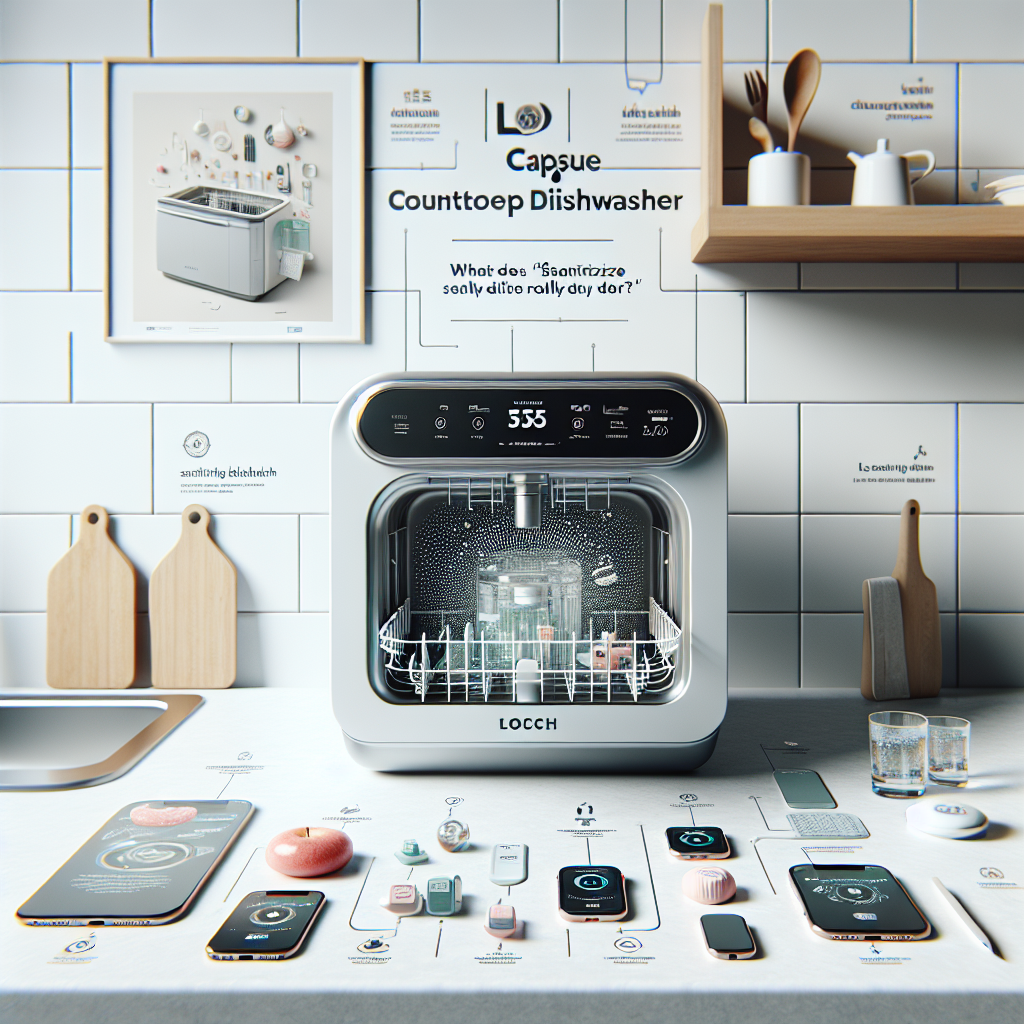
Countertop dishwashers have always lived in a weird corner of consumer tech: part appliance, part lifestyle accessory, and part “please don’t look under my sink.” They tend to be either too bulky for small counters or too small to feel worth the hassle. Every few years a new model shows up promising to fix the tradeoff triangle of size, speed, and actually-clean dishes.
Enter the Loch Capsule, a narrow, tall countertop dishwasher built for tiny kitchens, RVs, and the broader ecosystem of people who have strong feelings about handwashing. It’s the subject of a recent review by Thomas Ricker at The Verge, which is the original RSS source for this story. Ricker’s verdict is refreshingly nuanced: the Capsule is excellent at what it does, but it’s also a niche product that asks you to rethink space, water, and power in small living setups.
This article expands on that review with broader context: how this class of appliance fits into small-space living, what “sanitizing” really means in appliance standards, where UV-C fits (and doesn’t), and how to evaluate the Capsule against alternatives. Consider this the long-form, mildly amused tech reporter’s guide to a very specific kind of luxury.
What the Loch Capsule is (and why people keep trying to reinvent dishwashing)
The Loch Capsule is a countertop dishwasher with a few notable design choices that set it apart from the “microwave-shaped box” crowd:
- It’s tall and narrow, so it takes less counter width while still accommodating larger plates and some pans.
- It can run without permanent plumbing thanks to an external fresh-water tank and a drain hose setup. (Plumbing hookup is optional.)
- It aims for very fast cycles, with a headline “15-minute” wash that—per real-world testing—lands closer to 20–25 minutes in practice.
- It adds UV-C functionality for waterless sanitizing of certain small items like phones and earbuds, plus optional UV assistance for a fruit/veg wash mode.
In The Verge’s review, Ricker tested the Capsule in a tiny house and in a van over a long road trip, which is exactly where these devices either become your best friend or your most expensive countertop decoration. He reports that it can wash and dry roughly two place settings quickly at temperatures up to 75°C (167°F), and that its stainless steel tub improves drying and odor control compared with many plastic-tub competitors. citeturn2view0
So why all the hype? Because dishwashing is one of those chores that becomes disproportionately painful when you remove the infrastructure a normal kitchen takes for granted. In a small apartment, a built-in dishwasher might be impossible. In a tiny house, you may not want to devote cabinet real estate to a full-size unit. In vanlife, every gallon and watt becomes a line item in your personal budget spreadsheet. And in all of those environments, handwashing is… well, a hobby you didn’t sign up for.
Key specs and what they mean in real life
Let’s translate the core numbers into practical consequences. From The Verge’s reporting and Loch’s own documentation, a few stats stand out:
Size and weight: small footprint, but it’s not “cute small”
The Verge lists the Capsule at 46.5 × 26.2 × 51.5 cm (18.3 × 10.3 × 20.3 inches), with an internal volume around 30 liters, and a weight of about 12 kg (26.4 lb). citeturn2view0
That footprint is clever: you’re trading counter width for height and depth. In some kitchens, that’s a win because width is the scarce dimension. In others (especially with low cabinets), the height can be a dealbreaker. If you’re planning to stash it, 26 pounds is “carryable,” not “effortless.”
Wash cycles: fast is real, but “15 minutes” is marketing math
Loch’s FAQ lists a range of programs, including a 15-minute quick wash, longer daily/heavy/intensive modes, and an eco program. citeturn0search1
In real-world testing, The Verge found the advertised 15-minute mode typically takes 20–25 minutes end-to-end. That’s still fast—just not physics-breaking fast. citeturn2view0
For normal living, the difference between 15 and 25 minutes doesn’t matter much. In vanlife, where you may be timing loads around solar input or inverter limits, it can.
Water usage: measured in liters, not “eh, it’s fine”
The Verge measured about 2.5 liters (0.66 gallons) used in the fast cycle, and close to 4 liters in the most intensive mode. citeturn2view0
Loch’s own FAQ gives similar ballparks: the quick cycle is listed around 2.69 L and the longest cycles around ~4 L. citeturn0search1
Those are low numbers compared with many countertop dishwashers (which often land in the multi-gallon range), but they’re not automatically “better than handwashing.” The moment you start pre-rinsing heavily, you can erase any water advantage. The moment you start using paper towels to wipe grease, you’ve just moved the resource cost into another category. Efficiency is always a system problem.
Power draw: the quiet part is that “portable” still means real watts
In testing, The Verge saw energy consumption around 220–300 Wh for the fast cycle, with peak draw around 900 W. citeturn2view0
That peak matters. Many van setups can handle 900W, but not all—especially if other loads are running. In an apartment, 900W is fine. In a tiny house with limited circuits, it depends.
Noise: 56 dB is not a whisper in a 100-square-foot home
The Verge measured around 56 dB at one meter—noticeably louder than a typical built-in dishwasher in the “quiet” category, which can be in the 40s or even high 30s dB. citeturn2view0
Noise is one of those specs that gets ignored until you live with it. In a normal house you can close a door. In a van, the door is basically your face.
The stainless steel tub: not glamorous, but it matters
Many budget countertop dishwashers use plastic tubs. Stainless steel tubs are more common in midrange and premium built-ins because they handle heat better, resist staining and odors, and can support more effective drying strategies.
The Verge specifically notes the Capsule’s stainless tub as a differentiator that helps with drying speed, durability, hygiene, and odor control. citeturn2view0
In small machines, drying is often where the experience falls apart. You open the door and everything is technically clean but physically wet, which means you still have to air-dry, towel-dry, or live in a perpetual state of damp dish purgatory. A stainless tub doesn’t magically solve that, but it gives the machine more thermal headroom to make drying less disappointing.
UV-C gadget sanitizing: useful feature or pandemic-era leftover?
One of the Capsule’s headline tricks is a waterless UV-C mode designed to sanitize small items—think phones, earbuds, baby bottles, keys, and other “I touch this 400 times per day” objects. The Verge reports the Capsule uses UV-C in the 265–275 nm range. citeturn2view0
UV-C is a legitimate disinfection technology used in controlled environments, but consumer implementations deserve healthy skepticism. There are two separate questions:
- Does UV-C work? Yes, UV-C can inactivate microorganisms on nonporous surfaces when the dose, distance, exposure time, and line-of-sight coverage are appropriate.
- Is it safe and effective in this product as used by normal humans? That depends on enclosure design, shielding, interlocks, exposure time, reflectivity, and whether the objects have shadows/crevices that block UV.
Regulators have warned that certain consumer UV products (notably handheld UV wands) can expose users to unsafe levels of UV radiation if poorly designed or misused. The FDA has specifically cautioned consumers about UV wands that may injure skin and eyes and recommends safer alternatives when products lack safety features. citeturn1search2
A countertop dishwasher’s UV-C mode has one major advantage over a wand: it can be a closed box with interlocks. If designed properly, that’s far safer than waving a UV source around your living room like a sci-fi prop. But there’s still a practical limitation: UV is line-of-sight. If your earbuds are in a case, or your phone has grime in creases, UV won’t reach everything. “Sanitize” in marketing terms can mean “reduce some surface microbes,” not “make this a surgical instrument.”
My take: UV-C in the Capsule is a nice extra for certain scenarios—especially baby items and travel gear—but it shouldn’t be the primary reason you buy the appliance. Consider it a bonus feature that may reduce surface contamination, not a replacement for normal cleaning or common sense.
What “sanitizing” means in dishwasher land (and what it doesn’t)
In the US, dishwasher sanitization claims often relate to standards like NSF/ANSI 184 for residential dishwashers. NSF explains that NSF/ANSI 184 covers public health and sanitation requirements and that certified residential dishwashers must achieve a minimum 99.999% (5-log) reduction of bacteria on the sanitizing cycle and reach a final rinse temperature of 150°F (about 65.6°C). citeturn0search0turn0search3
Two key nuances:
- “Sanitize” is cycle-specific. NSF notes the performance is verified when the unit is operated on the sanitizing cycle. citeturn0search0
- Certification is not automatic. A product can reach high temperatures and still not be NSF certified unless it has been tested and certified to the standard.
The Verge review talks about the Capsule reaching up to 75°C (167°F), which is above the final rinse temperature requirement cited by NSF for sanitizing claims in residential machines. citeturn2view0turn0search0
That said, temperature alone isn’t the whole story: time, detergent chemistry, spray coverage, and validated test conditions matter. If you’re buying for immunocompromised household needs, you’ll want to look for explicit certification claims and documentation rather than relying on “it gets hot.”
The real target market: tiny homes, vans, and people who hate compromise
Countertop dishwashers are often pitched as “apartment friendly,” but the Capsule is more specifically tuned for scenarios where you may not have, or want, permanent plumbing. That’s why the removable water tank is a big deal.
Ricker used it in a tiny home and a van and highlights the reality check: in resource-scarce living, even a very efficient dishwasher can feel extravagant. It’s not just the water and power—it’s the space, the loading complexity, and the daily ritual of filling and draining tanks. citeturn2view0
This is the kind of product that makes sense if:
- You cook frequently and generate daily dish volume.
- You have consistent power (shore power, robust inverter, or reliable solar + battery).
- You have a predictable way to refill and dispose of water.
- You value time and comfort over minimalism.
It makes less sense if you’re doing “true minimalist vanlife,” where every amp-hour is a negotiation, or if your cooking style is mostly one-pan meals and paper plates (I’m not judging; I’m reporting).
Performance claims vs. performance reality
The most important part of any dishwasher review is simple: are the dishes clean?
The Verge’s testing suggests the Capsule’s quick cycle is legitimately effective. Ricker loaded it with greasy plates and messy utensils (bacon grease, peanut butter, yogurt, espresso cups—basically the brunch aftermath of people who own knives) and reported that everything came out clean, hot, and mostly dry on the fast mode. citeturn2view0
That matters because many small dishwashers force you into long cycles to get acceptable results, which defeats the point if you’re buying a speed-focused model.
There are still physical constraints. The Verge notes that while a 12-inch pan’s diameter may fit, the handle did not fit as claimed in their case, so it required handwashing. citeturn2view0
If you own a lot of cookware with long handles, you should treat “fits pans” as “fits some pans.” In countertop dishwasher land, geometry is destiny.
Efficiency: comparing the Capsule to full-size and other countertop machines
Comparisons get messy fast because test procedures differ across appliance classes. Still, some broad context is useful.
ENERGY STAR benchmarks (for built-in residential dishwashers)
ENERGY STAR’s key product criteria (effective July 19, 2023) set maximums for annual energy and water per cycle. For example, standard-size ENERGY STAR dishwashers are listed at ≤ 240 kWh/year and ≤ 3.2 gallons/cycle; compact built-ins are listed at ≤ 155 kWh/year and ≤ 2.0 gallons/cycle. citeturn1search0
Those numbers are based on DOE test methods and assumed annual cycles, and they’re not directly comparable to a countertop unit with a removable tank. But they provide a sanity check: modern built-ins can be surprisingly water-efficient, especially compared with older machines people still remember as “that loud box that used half a lake.”
So where does the Capsule land?
In water terms, the Capsule’s fast cycle at roughly 0.66 gallons is extremely low. citeturn2view0
In energy terms, 220–300 Wh per cycle is not outrageous, but the 900W peak is the operational constraint for off-grid setups. citeturn2view0
The Verge also points out something consumers often miss: depending on your situation, it may use more energy and water than handwashing (especially if you’re disciplined and don’t run the tap). That’s not a condemnation of the product; it’s a reminder that in small-space living, behavior dominates efficiency outcomes.
How it stacks up against other countertop alternatives
Loch isn’t alone. Brands like Farberware, Comfee, Danby, and others have built small dishwashers with tank-based operation, multiple cycles, and varying noise/size tradeoffs. For a taste of the category, The Spruce has covered multiple countertop models and highlights noise as a differentiator, with some units rated in the low 50s dB and even lower for certain models. citeturn1news13
Meanwhile, Bon Appétit’s review of a Farberware countertop dishwasher frames the appeal in very human terms: it can work as well as a full-size machine for small loads, with relatively low water usage per cycle and the convenience of a built-in tank. citeturn1news14
The Capsule’s unique value proposition is less about simply being “a countertop dishwasher” and more about being a premium, design-forward, fast-cycle countertop dishwasher with stainless internals and UV features. Whether that’s worth the premium depends on how much you value those specific traits.
Setup and daily use: the part that determines if you’ll love it or resent it
In normal kitchens, dishwashers disappear into cabinetry and connect to plumbing you never think about. Tank-based countertop units make the invisible visible: you’ll handle water every time you use the machine unless you plumb it in.
The Verge describes typical setup as plugging it in, filling the clean-water tank, and running a drain hose to a sink. In tighter environments (like a van), hose length and waste handling can require additional planning, including optional waste tanks. citeturn2view0
There’s also the loading factor. Ricker compares loading the Capsule to “expert-level Tetris,” which is consistent with basically every compact dishwasher ever made. citeturn2view0
If you’re a neat-freak organizer, you might enjoy this. If you’re a “pile it in and pray” person, prepare for a learning curve.
Price and value: luxury in a very specific niche
The Verge lists the Loch Capsule at $459.99 in the US and notes discounting at the time of the review. citeturn2view0
That puts it in an awkward spot: significantly more expensive than many entry countertop dishwashers, while still being less capable (capacity-wise) than a built-in. Loch is clearly betting that its audience values design, portability, speed, and premium materials enough to pay for it.
There’s also product lineage. Loch’s Capsule originally appeared via crowdfunding, with a Kickstarter campaign that was funded in 2021 and shows updates through 2024. citeturn0search2
Crowdfunded hardware isn’t inherently bad (plenty of good products started there), but it does shape buyer psychology: people want reassurance about support, replacement parts, and long-term availability. Loch now operates like a standard consumer electronics/appliance brand with direct sales and documentation, which is the direction you want to see after a campaign phase.
A practical buying checklist (tiny house / vanlife edition)
If you’re considering the Capsule—or any similar countertop unit—here’s how I’d sanity-check your setup before clicking “Buy.”
1) Power: can your system handle the peak draw?
- In a home: a normal outlet is fine.
- In a van: verify your inverter continuous rating and surge capacity. The Verge observed peaks around 900W. citeturn2view0
2) Water: can you afford the liters?
- If you’re off-grid: budget 2.5–4 liters per run plus whatever you use for cooking and drinking. citeturn2view0turn0search1
- If you’re in an apartment: this is trivial—your bigger concern is where the unit physically lives.
3) Space: measure like you mean it
- Measure the counter footprint and the height clearance under cabinets.
- Remember you need room for hoses and for opening the door.
4) Noise: will it annoy you daily?
- 56 dB in a tiny space can feel loud, especially during sleep or calls. citeturn2view0
5) Lifestyle: do you actually create dishwasher-worthy loads?
- If you cook daily and hate handwashing: you are the target demographic.
- If you mostly eat out or cook one-pan meals: the Capsule may be an expensive way to wash two plates.
Implications: dishwashers as “home infrastructure,” shrinking to fit modern living
The Capsule is interesting beyond its own feature set because it reflects a bigger shift: appliances are adapting to smaller, more flexible living arrangements. The rise of tiny homes, micro-apartments, ADUs, and van conversions has created demand for “infrastructure-lite” devices—things that perform a traditional household function but don’t require permanent installation.
That trend also forces manufacturers into more transparent tradeoffs. When a dishwasher is built-in, it can assume plentiful water, stable power, and a drain. When it’s countertop and tank-fed, suddenly everyone becomes an amateur utilities engineer. You start asking questions like:
- How many liters does this cycle use?
- What’s the peak watt draw?
- How long is the drain hose?
- Where does the waste water go when the sink is… not nearby?
In that sense, the Capsule is less like a traditional appliance and more like a piece of “home tech” that lives in the same mental category as battery stations and compact induction cooktops.
So, should you buy the Loch Capsule?
If you’re in a small space and you want a dishwasher badly enough that you’re considering a countertop model, the Loch Capsule appears to be one of the more thoughtfully designed, premium options—especially if speed, stainless internals, and the ability to run without plumbing matter to you. The Verge’s review suggests the core job (cleaning dishes fast) is genuinely well executed. citeturn2view0
But it’s still a niche luxury, and the niche isn’t “people with small kitchens.” The niche is “people with small kitchens who have enough budget, enough counter real estate, enough power, and enough daily dish volume to justify a premium mini dishwasher.” That’s a smaller group than Instagram would have you believe.
If that’s you: congratulations, you’ve found a way to automate one of the most annoying chores in tiny-space living. If it isn’t: your sink will remain employed, and your budget will remain less angry.
Sources
- The Verge — “The Loch Capsule dishwasher is small, fast, and efficient — it even sanitizes gadgets” (Thomas Ricker, Jan 24, 2026)
- Loch Electronics — Capsule FAQ (programs, power and water consumption, UV/fruit modes)
- NSF — Dishwasher certification overview (NSF/ANSI 184 sanitization requirements)
- NSF — Home products standards portfolio (NSF/ANSI 184 summary)
- ENERGY STAR — Dishwashers key product criteria (effective July 19, 2023)
- FDA — Consumer warning about unsafe UV wands (UV-C safety context)
- Kickstarter — Capsule Personal Dishwasher campaign page (project background)
- The Spruce — Best countertop dishwashers (category context and comparisons)
- Bon Appétit — Farberware countertop dishwasher review (category comparison)
Bas Dorland, Technology Journalist & Founder of dorland.org