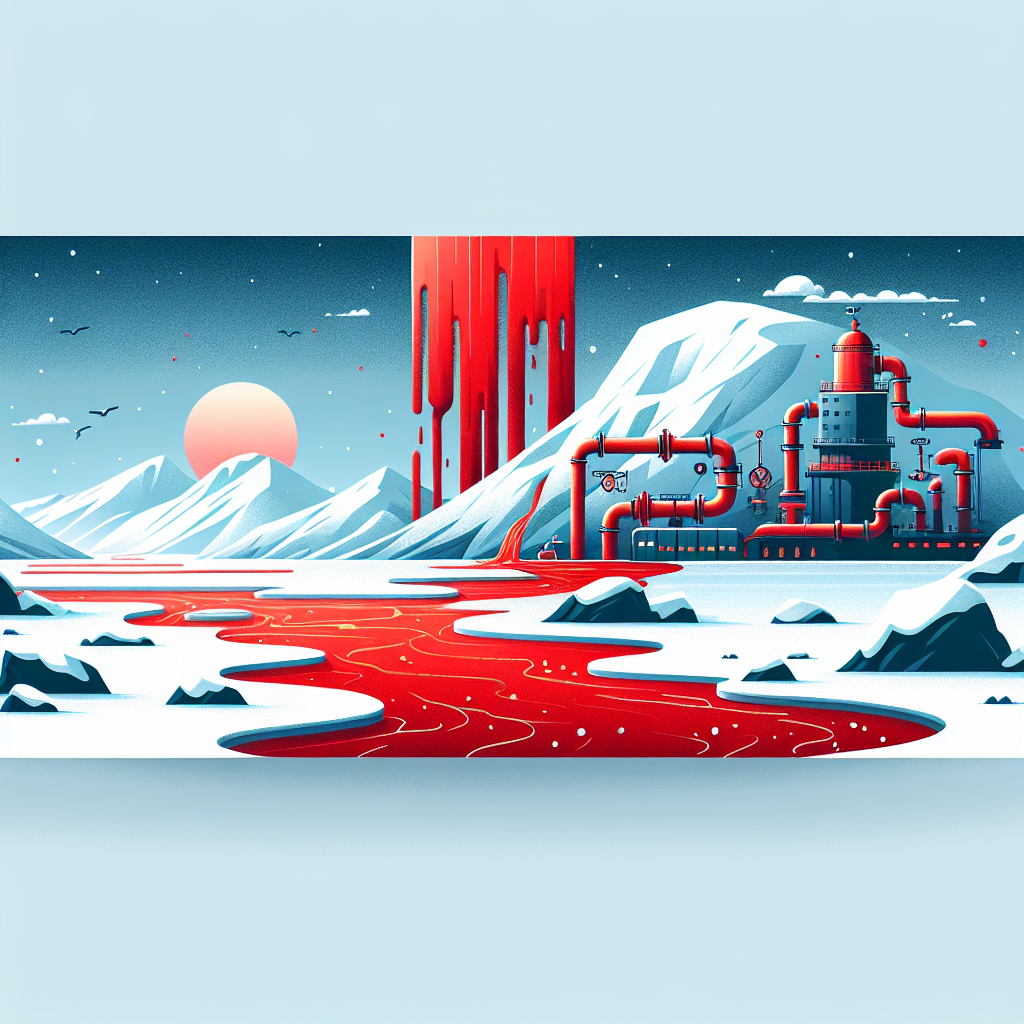
On February 24, 2026, WIRED published a story with a wonderfully confident headline: “The Last Mystery of Antarctica’s ‘Blood Falls’ Has Finally Been Solved.” The article, written by Simone Valesini (and credited by WIRED as translated from WIRED Italia), argues that scientists now have the missing physical mechanism that explains why the Taylor Glacier occasionally “bleeds” rusty-red brine onto its surface. citeturn1view0
As a technology journalist, I love it when a natural wonder turns out to be powered by something that feels uncomfortably relatable—like pressure building up in the wrong place until something cracks. If you’ve ever watched a clogged espresso machine sputter and then suddenly fire a terrifying stream of hot liquid across the counter, you already have the emotional intuition for Blood Falls. Antarctica just does it with ice, ancient seawater, and iron.
The new “final piece” is reported in a short open-access note in Antarctic Science, published online January 13, 2026, titled Glacier surface lowering and subglacial outflow coincide with Blood Falls discharge in the McMurdo Dry Valleys. The authors are Peter T. Doran (Louisiana State University), Matthew R. Siegfried (Colorado School of Mines), Hilary A. Dugan (University of Wisconsin–Madison), Kayla A. Hubbard (University of Wisconsin–Madison), and Jade P. Lawrence (University of Colorado Boulder). citeturn2view1turn3view1
In this article, I’ll unpack what the new research actually says, why it matters, and how a century-long Antarctic mystery ended up being solved by an unusually satisfying mashup of sensors, timing, and (let’s be honest) scientific luck.
What is Blood Falls, exactly?
Blood Falls is a striking feature at the snout (terminus) of the Taylor Glacier in Antarctica’s McMurdo Dry Valleys. Every so often, a reddish liquid emerges from fissures in the ice and stains the glacier like a horror-movie prop department got a government grant. The “blood” is not algae; it’s iron-rich, hypersaline brine that oxidizes when it hits air, turning a dramatic rusty red. citeturn1view0turn0search0
The site has been captivating researchers since it was first described in 1911 by geologist Thomas Griffith Taylor, who initially suspected the color might be caused by algae. That’s a very reasonable guess if you’ve never met Antarctica and its habit of doing chemistry at scale. citeturn1view0turn5search13
Over the decades, multiple questions attached themselves to Blood Falls like curious barnacles:
- Why is it red?
- How can liquid water exist in such cold conditions?
- Where does the brine come from?
- What forces it to erupt out of the glacier—sometimes in bursts?
Many of those were addressed in waves of research through the 2000s and 2010s, but the last one—the mechanical trigger—has been the stubborn holdout. The January 2026 Antarctic Science note focuses on precisely that final “how does it get pushed out?” piece. citeturn3view1
The chemistry and biology: a quick refresher (because it’s too good to skip)
Rust, not red algae
The red color is essentially “instant rust.” The brine contains dissolved iron (often discussed as ferrous iron in suboxic conditions); when it reaches the surface and contacts oxygen, iron oxidizes and precipitates as iron oxides, staining the ice. That’s the core explanation long covered in the literature and science reporting. citeturn0search0turn5search2
WIRED’s 2026 piece also highlights that researchers have described iron housed in nanoscale spheres alongside other elements, and that these particles likely connect to ancient microbial processes. citeturn1view0
Microbes under the ice, doing weirdly practical things
Blood Falls is also famous because it provides a rare window into a subglacial ecosystem. In a landmark 2009 Science paper, Jill Mikucki and colleagues described an active microbial assemblage in a sulfate-rich ancient marine brine beneath Taylor Glacier, with Fe(III) serving as a terminal electron acceptor in their metabolic system. In other words: even under an ice sheet, life finds a way—by doing chemistry that would make a battery engineer nod approvingly. citeturn5search0turn0search0
This matters beyond Antarctic trivia. Subglacial microbial systems are studied as analogs for potential life-supporting environments in extreme settings, including icy worlds beyond Earth. The McMurdo Dry Valleys in particular are frequently discussed as Mars analog terrain because they are cold, dry, and geochemically unusual—an environment where “habitable” becomes a narrow, technical word rather than a vibe. citeturn4search0
So what was the “last mystery”?
By the time you reach the mid-2010s, scientists had a strong sense of what Blood Falls is and where the brine likely resides and moves. For example:
- A 2015 Nature Communications study used airborne transient electromagnetic (AEM) sensing to map zones of low resistivity interpreted as subsurface brines in Taylor Valley, including systems extending beneath glaciers and lakes. citeturn4search0
- A 2017 Journal of Glaciology paper mapped an englacial brine zone using radio-echo sounding and argued for brine injection into basal crevasses and routing toward Blood Falls via hydraulic potential gradients. citeturn5search2
- A 2020 Antarctic Science paper by Lawrence, Doran, Winslow, and Priscu identified subglacial brine intrusions into the West Lobe of Lake Bonney and used temperature as a tracer to study winter dynamics. citeturn4search1
But why the brine sometimes breaks out at the surface in discrete events—and why those events appear as short bursts—has been difficult to pin down. You can know there’s pressurized fluid under ice and still not know what, specifically, triggers release at a particular time and geometry.
The new 2026 note doesn’t claim to have mapped every pipe and valve in the glacier. What it does claim—carefully, in the way good short papers do—is that a particular discharge event in September 2018 was captured by three independent observing systems at once, and that the combined signal is consistent with a brine drainage/outflow event tied to changes in glacier motion and surface elevation. citeturn3view2turn2view2
The 2026 breakthrough: pressure, cracking, and a glacier that briefly hits the brakes
A “serendipitous alignment” of sensors
One of my favorite phrases in the 2026 Antarctic Science note is that it reports on a “serendipitous alignment of observations”. That’s scientific-speak for: “we had multiple instruments running, and the universe finally decided to schedule the weird event while the batteries were still alive.” citeturn3view2
The team combined:
- Continuous GPS data from a station on Taylor Glacier (TYLG), installed in 2017, used to track ice motion and subtle vertical changes. citeturn2view2turn5search1
- Time-lapse camera imagery focused on Blood Falls to see the onset and progression of discharge. citeturn2view2
- Thermistor strings (temperature sensors) in the West Lobe of Lake Bonney to detect cold anomalies consistent with brine injections at depth. citeturn2view2turn4search1
Together, these datasets captured a coherent story: around the time discharge began, the glacier surface showed a small but measurable lowering, and ice velocity decreased. citeturn3view2
What they observed in 2018
According to the note, brine discharge at Blood Falls began on September 10, 2018. Time-lapse imagery indicated new discharge continuing later in the month, and the authors describe an extended discharge event characterized by episodic pulses over roughly ~1 month. citeturn2view2turn3view2
Meanwhile, the GPS station recorded an approximately 15 mm downward drop of the glacier surface coincident with the outflow event (the paper describes an “~15 mm down drop”). The authors interpret the combined signals as evidence of a subglacial brine drainage event. citeturn3view2
The key mechanism: subglacial pressure changes and “hydraulic braking”
The WIRED summary (and the underlying scientific note) points to pressure variations beneath the glacier as the driver. As the glacier creeps downstream, it can compress subglacial and englacial pathways, building pressure in brine-filled channels or reservoirs. Once stresses become too high, fractures and crevasses provide a pathway for brine to escape—often in bursts. citeturn1view0turn3view1
The 2026 note further argues that the extended discharge event reduces subglacial water pressure, which in turn lowers the surface and reduces ice velocity. This is the “hydraulic brake” concept WIRED mentions: draining pressurized fluid changes basal or internal conditions in a way that temporarily slows glacier movement. citeturn2view2turn1view0
That’s a neat inversion of how many people intuitively think about water under ice. In many glacial systems, more meltwater at the base can lubricate sliding and speed up flow. Here, the key observation is that a drainage/outflow event is associated with deceleration—suggesting a more complicated relationship between brine pressure, effective stress, and how this particular cold-based glacier “grips” its bed and internal structure. citeturn2view2turn5search2
Why Blood Falls is a sensor-fusion story (and yes, that’s a tech compliment)
For dorland.org readers who spend their days building observability stacks, Blood Falls is a reminder that nature often requires the same strategy: correlate multiple independent signals to reduce ambiguity.
Any single dataset here could have been argued away:
- GPS motion anomalies without imagery might look like instrumentation drift or unrelated ice dynamics.
- Time-lapse imagery without subsurface temperature context might not tell you whether the event is local or part of a broader brine system feeding the lake front.
- Thermistor anomalies without visible discharge might get filed under “lake weirdness” (which, to be fair, Antarctic lakes excel at).
But when all three line up—timing, directionality, and plausible coupling—you can start to build a causal narrative rather than just a scrapbook of interesting plots. The authors explicitly frame the simultaneous recording as a rare coherent signal of a subglacial brine drainage event. citeturn2view2
How this fits with the last decade of Blood Falls research
The 2026 result doesn’t overwrite previous work. It sits on top of it like a final capstone: previous studies mapped the brine and argued for pathways; the new observation adds evidence for how discharge events relate to pressure changes and glacier motion.
From “there is brine” to “here are the pipes”
The 2015 Nature Communications paper used airborne electromagnetics to infer extensive brines beneath Taylor Valley, including a system emanating from below Taylor Glacier into Lake Bonney. This matters because it reframes Blood Falls as a visible outlet of a broader subsurface hydrologic system, not an isolated oddity. citeturn4search0
The 2017 Journal of Glaciology paper used radio echo sounding to delineate a subhorizontal zone of englacial brine upstream and proposed a network of basal crevasses enabling injection of pressurized subglacial brine into the ice, routed toward Blood Falls by hydraulic potential gradients. citeturn5search2
In 2020, the Lake Bonney brine intrusion study emphasized that brine can enter the lake not only through surface discharge at Blood Falls but also from subglacial entry points along the glacier face. citeturn4search1
The 2026 note explicitly cites this body of work in its extract and introduction, describing brine entering the West Lobe of Lake Bonney along the glacier front and referencing prior geophysical detection and delineation of subglacial flow pathways. citeturn3view1turn3view2
What’s new is the event-level coupling
What’s different in 2026 is the focus on an event—a discharge episode with coordinated records from GPS, imagery, and lake temperature sensors—and an argument that the discharge reduces pressure and slows the glacier. citeturn2view2
If you’re looking for the “last mystery” in plain language, it’s this: not merely that brine exists, but how the system behaves like a pressurized network that sometimes releases fluid in pulses, and how that release couples back into ice dynamics.
Implications: why anyone beyond Antarctica’s fan club should care
1) Subglacial hydrology isn’t just meltwater—brines change the rules
When people talk about water under ice, they often mean meltwater driven by surface temperature or geothermal heat. Blood Falls reminds us there are other categories: ancient seawater-derived brines, cryoconcentrated fluids, and chemically stratified systems that persist far below 0°C because salinity depresses the freezing point. citeturn5search2turn1view0
That’s important for modeling because brines have different viscosity, density, and freezing behavior than freshwater. They can create stable liquid reservoirs and pathways in otherwise “cold-based” glaciers, challenging older assumptions about what a glacier at −17°C air temperatures can do internally. citeturn5search2
2) Observational infrastructure in extreme environments pays off—eventually
One quiet hero of this story is long-term instrumentation: a GPS station installed in 2017, ongoing lake temperature measurements, and cameras that don’t mind the cold (or at least were engineered to mind it less than a human would). citeturn2view2turn5search1
The GPS dataset itself is managed as part of the NSF geodetic facility ecosystem (GAGE/EarthScope), with a publicly described station and data range. That’s the kind of research plumbing that rarely makes headlines but enables them. citeturn5search1
3) The “iron pipeline” question: micronutrients, lakes, and possibly oceans
Blood Falls is not just a visual spectacle; it’s a mechanism for moving iron and other solutes from rock–water–microbe interactions beneath a glacier into surface environments like Lake Bonney. The 2015 Nature Communications paper even discusses the possibility of submarine groundwater discharge as an unaccounted iron and silica source, and it estimates that a release event could deliver hundreds of kilograms of bioavailable iron to Lake Bonney based on discharge volume and concentrations. citeturn4search0
Now, we should be cautious: one Antarctic feature doesn’t rewrite Southern Ocean biogeochemistry by itself. But it does underscore that “hidden” subglacial and subpermafrost systems can transport nutrients in ways that classic surface-only hydrology misses.
4) Astrobiology: not proof of aliens, but better Earth analogs
Blood Falls keeps popping up in astrobiology conversations because it bundles three things planetary scientists care about: liquid water, energy gradients (redox chemistry), and microbial life in an extreme environment. The microbial cycling described in the 2009 Science paper, paired with the existence of widespread brines inferred by geophysics, strengthens the argument that salty subsurface environments can stay active over long timescales. citeturn5search0turn4search0
The 2026 mechanical explanation doesn’t change the biology directly, but it helps explain how such ecosystems might periodically exchange materials with the surface—an important piece when considering how one might detect life remotely (on Earth or elsewhere).
Will climate change affect Blood Falls?
WIRED ends with an honest shrug: the impact of global warming on this system remains unknown. That’s not a cop-out; it’s a realistic statement about a complex coupled system where temperature, ice deformation, fracture mechanics, and subsurface hydrology all interact. citeturn1view0
It’s also a reminder that “solving” a mechanism doesn’t make a system static. It makes it modelable. And modelable is where the real work begins—because once you have a plausible mechanism (pressure build-up and release), you can ask: how does changing ice thickness, deformation rates, or brine distribution shift the frequency and magnitude of discharge events?
A brief, mildly funny takeaway
Blood Falls’ final mystery appears to have been solved by the oldest plot device in both engineering and horror films: pressure. The Taylor Glacier compresses its brine pathways, pressure increases, fractures open, brine bursts out, and the glacier briefly slows down—like it just remembered it left the oven on back at base camp. citeturn1view0turn2view2
And the most satisfying part? The answer didn’t come from a single “magic” instrument. It came from correlating GPS motion, thermal anomalies, and imagery—an Antarctic version of a distributed tracing dashboard, except your on-call rotation is the austral winter.
Sources
- WIRED — “The Last Mystery of Antarctica’s ‘Blood Falls’ Has Finally Been Solved” (Simone Valesini, Feb 24, 2026; translated from WIRED Italia). citeturn1view0
- Antarctic Science — “Glacier surface lowering and subglacial outflow coincide with Blood Falls discharge in the McMurdo Dry Valleys” (Doran et al., published online Jan 13, 2026). citeturn2view1turn3view1turn2view2
- Nature Communications — “Deep groundwater and potential subsurface habitats beneath an Antarctic dry valley” (Mikucki et al., 2015). citeturn4search0
- Journal of Glaciology — “An englacial hydrologic system of brine within a cold glacier: Blood Falls…” (Badgeley et al., 2017). citeturn5search2
- Antarctic Science — “Subglacial brine flow and wind-induced internal waves in Lake Bonney, Antarctica” (Lawrence et al., 2020). citeturn4search1
- Science (via PubMed) — “A contemporary microbially maintained subglacial ferrous ‘ocean’” (Mikucki et al., 2009). citeturn5search0
- GAGE/UNAVCO (EarthScope/NSF facility) — TYLG Taylor Glacier GPS station dataset info (Gooseff & Doran, 2017). citeturn5search1
- Chemical & Engineering News — “Blood Falls Explained” (Sarah Everts, 2009). citeturn0search0
Bas Dorland, Technology Journalist & Founder of dorland.org